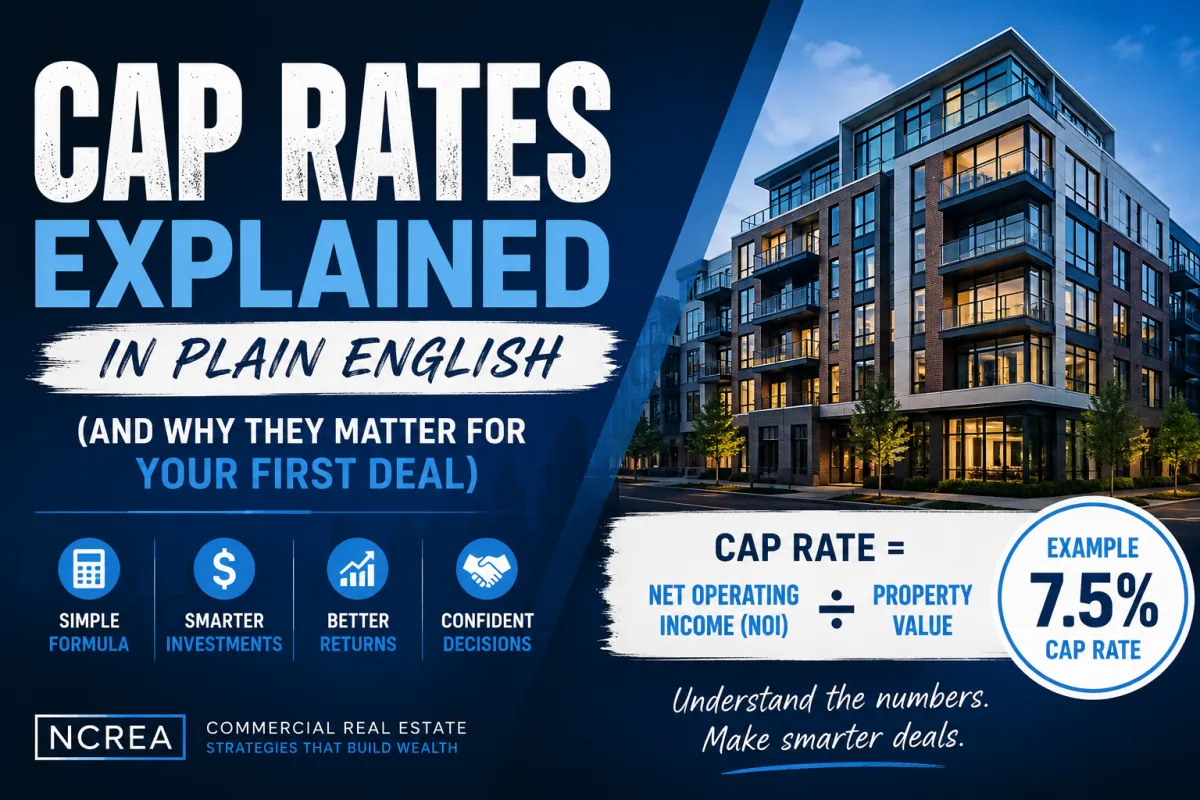
Cap Rates Explained in Plain English (and Why They Matter for Your First Deal)
Don't Let One Little Formula Keep You Out of Commercial Real Estate
If there's one term that scares more residential agents away from commercial real estate than any other...
It's cap rate.
I've met countless agents who say things like:
"Commercial just seems too complicated."
Or...
"I'm not a numbers person."
The funny thing?
Cap rates are actually incredibly simple.
In fact, once someone explains them in plain English, most people wonder why they were ever intimidated in the first place.
So let's fix that.
By the end of this article you'll understand:
What a cap rate really is
Why investors care so much about it
How to calculate one
Why it matters on every commercial deal
Let's dive in.
What Is a Cap Rate?
Think of a cap rate like the interest rate on an investment.
Except instead of earning interest from a bank...
...you're earning income from a building.
A cap rate tells an investor:
"If I paid cash for this property today, what annual return would I earn?"
That's it.
It's simply a way of comparing investment opportunities.
The Formula (Don't Panic)
The formula looks like this:
Cap Rate = Net Operating Income ÷ Property Value
Looks intimidating?
Let's make it ridiculously simple.
Suppose an apartment building earns:
Annual rental income:
$200,000Operating expenses:
$50,000That leaves:
Net Operating Income (NOI)
$150,000
Now imagine the property is worth:
$2,000,000
The cap rate becomes:
150,000 ÷ 2,000,000 = .075
Or...
7.5%
That's all a cap rate is.
What Does That Number Actually Mean?
Think of it this way.
If you bought that building with cash...
Your investment would earn approximately 7.5% annually before financing.
The higher the cap rate...
Generally speaking...
The higher the potential return.
But...
Higher returns usually come with higher risk.
Lower cap rates often indicate:
Better locations
Stronger tenants
More stable markets
Greater demand
Investors constantly compare cap rates because they help answer one important question:
"Which property gives me the best return for my money?"
Why Residential Agents Get Confused
Residential agents are used to asking questions like:
Does the kitchen look updated?
Is the neighborhood desirable?
What are comparable homes selling for?
Commercial investors ask different questions.
They ask:
How much income does it produce?
Can rents be increased?
What are operating expenses?
What's the cap rate?
How can I increase the value?
It's a completely different mindset.
You're evaluating a business.
Not just a building.
Cap Rates Drive Property Values
Here's something many new agents don't realize.
In residential...
The market determines value.
In commercial...
Income determines value.
Let's look at an example.
Imagine two identical apartment buildings.
Building A earns:
$100,000 NOI
Building B earns:
$140,000 NOI
Which one is worth more?
Building B.
Even though they look exactly the same.
Because investors buy income.
Not granite countertops.
That's why understanding cap rates changes the way you look at commercial property forever.
What Makes Cap Rates Go Up or Down?
Several things influence cap rates.
Market Demand
Strong investor demand usually pushes cap rates lower.
Interest Rates
Higher borrowing costs often increase cap rates.
Risk
Higher-risk properties generally trade at higher cap rates.
Property Condition
Well-maintained buildings often command lower cap rates because they're seen as safer investments.
Location
Prime locations almost always produce lower cap rates.
Why?
Because investors are willing to accept slightly lower returns for more predictable long-term growth.
One Mistake New Agents Make
Many new agents think:
"If a property has a higher cap rate, it's automatically a better investment."
Not necessarily.
Sometimes a high cap rate means:
Deferred maintenance
Poor tenant quality
High vacancy
Weak location
Context matters.
Great commercial agents don't chase the highest cap rate.
They understand why it's high.
Why This Matters for Your First Commercial Deal
You don't need to become a financial analyst.
You don't need spreadsheets with hundreds of formulas.
You simply need to understand what investors are looking at.
Once you understand cap rates...
You can:
Have better conversations with investors.
Analyze deals with confidence.
Spot opportunities faster.
Build credibility immediately.
And that's exactly what separates commercial agents from residential agents.
The Good News
If this article made cap rates feel simpler...
Imagine what happens when someone walks you through:
Finding deals
Talking to owners
Prospecting investors
Evaluating opportunities
Negotiating commercial transactions
That's exactly why I created the 3 Commercial Real Estate Secrets masterclass.
It's designed specifically for agents who think commercial feels overwhelming.
Once you understand the framework...
You'll realize it's actually much simpler than most people believe.
The Bottom Line
Commercial real estate isn't difficult because the math is complicated.
It's difficult because no one ever explains the math in plain English.
Now you know what a cap rate is.
More importantly...
You understand why it matters.
And that's the first step toward thinking like a commercial investor instead of a residential agent.
If you're ready to take the next step, join my next free 3 hour training specifically on deal math and how to analyze deals.
Next Steps: Learn How to Break Into Multi-Family the Smart Way
If this opened your eyes to what’s possible in commercial real estate, don’t let the momentum fade.
🎯 Step 1: Join my free training — Deal Math Live
🎯 Step 2: Explore the 6-Figure Commercial Playbook to master the 6-step deal process.You’re closer than you think to your first commercial deal — and your next level of income.
To your success,
Michael Simpson
Founder, NCREA

